Showing posts with label grammar. Show all posts

Saturday, 11 June 2022

Embedded grammar: The Eureka Effect!

As you probably know, I have been working with the talented Dr Gianfranco Conti and Dylan Viñales on a new Spanish Grammar book aimed at foundation level, underpinned by EPI methodology and a lexicogrammar approach to teaching MFL. The book is called  Spanish Verb Pivots, title which reflects the core of the EPI methodology and which, Gianfranco has explained really well in social media and in the book itself. 

I thoroughly enjoyed co-writing this book with such gifted practitioners but what I enjoyed the most was the opportunity to implement in a systematic way, how I have been approaching grammar in my lessons for years. 

I don’t teach grammar in isolation, I did at some point, and I quickly realised it was useless, as practising a set of rules over and over again could lead to excellent choral conjugation of verb paradigms but made no difference in reaching  fluency, hence leading to frustration! 

Instead, I soon realised that grammar should be taught embedded in the lexicon we teach via chunks. For that I use my own sentence builders. We practise those chunks constantly during lessons, we analyse patterns, I plant the seed, quoting Dr Conti, on grammar to come, students become fluent on a particular topic, and then, only then, I teach grammar explicitly. At that point grammar becomes a dejá vu feeling and most likely to be automatised. 

Grammar is embedded in the language, so let’s deconstruct it, yes, but only once students have internalised target structures/vocab, so that they can develop creativity. 

An example: The past tense in Y8

This is how I teach the topic of holidays in the past in Y8, always after having learned to talk about holidays in the present, which will lead to the learning of the Past tense in Spanish.

Modelling stage

At this stage I introduce the following Sentence Builder via choral repetition and showing the Spanish written graphemes and the English, so there's no confusion whatsoever on what structures mean! Thinking about the new GCSE, this Sentence Builder, already incorporates High Frequency words: such as the verbs intentar and encontrar. The Sentence Builder aims for students to learnn the I form of the past tense, including irregular verbs and be fluent with them.


We carry out lots of modelling activities as outlined in this blogpost here. At this stage I work mainly with MWBs to check for understanding. I also allow students to have their Sentence Builders with them: scaffolding. Lots of input activities take place throughout the Modelling stage, which will last a couple of lessons. 

By the way, I only teach, depending on ability, a row at a time in the Sentence Builder above. For example, I would not teach opinions and reasons, at the same time as all those verbs in the Past Tense to avoid cognitive overload.  

Similarly, when doing listening/translations/dictations, I always make sure I interleave past structures and vocabulary: embedded retrieval practice! This stage finishes with the explicit learning of the chunks for a spelling test. Quizlet, Memrise and even better, the Sentence Builder site are great tools to assist students in this learning, which I do as homework tasks.

Structured Practice Stage

Following the MARS EARS approach to lexicogrammar teaching, after 2 modelling lessons per row, I would expect students to start producing some sentences with guidance. I always do this as a whole class to start with with MWBs and orally. 

Digital tools are great at this stage, such as Flippity, Wheel of names, or Sentence Builsders site, as well as some old classics, like any Battleships, Oral Ping-Pong, pyramid translations, board games or just any information gap activity! Have a look at this blogpost for ideas. 

At this stage, we can start looking at grammatical patterns in the sentence builders! Homework tasks may include more extensive reading, as well as guided written practice: tangled translations for example. In this blogpost I give some ideas on how to revamp and maximise the digital activities we use in lessons as homework tasks, saving lots of time. 

Fluency stage

The hardest stage! Which, paradoxically, seems to be ignored. This will take three/four lessons and it is similar to the previous stage but I expect students to come up with their own answers to specific questions under time constrictions! 

Speed dating, stealing sentences with initials, board games with questions or the beginning of a sentence, flippity with a question and a expression to be used in the answer are some of my favourite activities here! A summary of the activities at each stage can be seen below:


Somewhere in the fluency stage I teach grammar! 

Inductive grammar: The Eureka Effect!

As students have had so much practice with the structures I want them to learn, I expect my pupils to work out the rule of the past tense for all persons from a text that we analyse. Remember, they already know the present and the I form of the past tense extremely well! This is the Eureka effect of this approach!


Students work in pairs to come up with a rule, we check it, we agree on it and then I explain it, explicitly, again. They take notes and then, as if it was a sentence builder, I follow the same process of modelling, structured practice, fluency tasks, again but referring to Grammar. 


Modelling Grammar

This involves carrying out the same tasks done at the Modelling Stage, when learning our sentence builder,  but now using the we, he/she, you, they persons of the past tense: dictations, reading activities, listening tasks, translations. At this stage a homework task will involve to learn the six verb endings for -ar and -er/-ir verbs in Spanish and a test, which just will inform me if students understood this grammar point but which is not a reflection of student success in Spanish! 

Practising Grammar

Again, we carry out the same tasks as in the structured practice stage, but now focussing on the grammar point we are studying: the past tense. 

This is where learning grammar can be great as there are lots of games I can incorporate at this point! Basically, any game like connect four, snakes and ladders, stone/paper/scissors, Jenga, four in a box, you name it, works here! My students love grammar because it is fun and they experimented a Eureka feeling, which leads to motivation and "a can do" attitude. Remember, we don’t just conjugate verbs but we embed the past tense into communicative utterances! More traditional worksheets work very well here too, with an element of competition! 

Being fluent with Grammar

This is the Holy Grail of MFL! If students  are fluent in grammar, by default if taught via a lexicogrammar methodology, students should be fluent in the target language! Easier said that done! 

This will involve a few lessons and lots of interleaving over the years! But at this stage, I expect students to be able to narrate, in a simple way and quickly, what they and other members of their family did during the holidays! All the fun activities from the previous stage work, but with a time limit. 

This stage must be reinforced by carefully planned homework tasks that will allow students to be creative, while still having time to think about grammatical rules: Creative Writing tasks are ideal at this stage. 

So, grammar is clearly embedded in the learning process and it leads itself to have a Eureka effect. 

It can be explicitly taught but not at the beginning of the learning journey but towards the end and not as end on its own, but as a tool to be able to communicate fluently in the target language. 

Similarly, any grammar point will neeed to be revised many times and in different contexts to be fully assimilated: free time by saying what students did yesterday or what happened in a film; school by saying what students studied yesterday etc… 

I would like openly to thank Dr Gianfranco Conti and Dylan Viñales for the opportunity to allow me to work and learn from them during the creation of Spanish Verb Pivots. It’s been such a pleasure.  

Saturday, 19 September 2020

Teaching MFL at ALevel: A 10 step guide!

Teaching ALevel is very different from teaching KS3 and KS4 in the UK, or not? The approach is certainly different.  At this stage, Sentence Builders are not a must anymore, although learning some chunks with difficult expressions to express an idea, can be powerful! Similarly, the principles from cognitive science about how our memory works (transferring information/knowledge from the working memory to the long term memory) prevail. This means, that the recycling of ideas, structures, vocabulary, working with texts, milking them, teaching to analyse facts etc.. will need to be extensively modelled, practised with scaffolds until it leads to Fluency. Rosenshine and lexicogrammar still apply to A Level teaching.

At this stage, teaching single words is beneficial and studying grammar explicitly, as well as implicitly, via texts, is essential. Similarly, teaching the ALevel syllabus is not just about teaching a MFL but developing high thinking order skills, studying literature, film studies and most importantly, assimilating facts about the target country which students must analyse and draw conclusions from, this will need to be modelled and extensively practised! It is like a General Studies course but in a MFL, not easy! 

The Setting of High Expectations: The iceberg model!

On the first day of lessons, I go through our MFL Sixth Form booklet which, clearly explains what is expected from our Alevel students from day one! Normally the gap between GCSE and Alevel is big! The booklet makes reference to the Iceberg metaphor: the visible part of the iceberg represents lessons, while the invisible part underneath, refers to self study work!

The MFL Sixth Form Handbook

The handbook points out the skills that will need to be developed, under the surface outside lessons, to be successful in the course, as well as providing a model timetable of self study. Lesson work, alone, it is not enough! Finally, it gives students ideas on how to practise the different skills of reading, listening, vocabulary and grammar learning, independently. For that I also create a bank of resources for students to choose from to carry out their own independent study tasks, as explained in their booklet. Zig-Zag podcasts, films and Authentik reading resources are invaluable here. See picture below. 


My 10 Step Guide

The approach I use to teach the Spanish Alevel AQA syllabus, with some variations, is the Teaching Through Text based approach, which correlates nicely with lexicogrammar and whose foundation is rooted in cognitive silcience. This is what I do for each given topic, say, Changes in Family in Spanish society, in Y12.

1. I start my sequence of lessons with an oral activity similar to those carried out at GCSE level on the topic of family. This is normally a group discussion activity where students talk about themselves and their families, with a final thought proving question, in Spanish, such as what does a typical family look like? Is it normal that grand parents live with their children?  Some key vocabulary can be given to conduct the activity, or this may appear spontaneously while carrying out the task. This is a Retrieval classic task. 

2. At a second stage, in the same lesson, I show students some photos in relation to the topic, in this case I would show them photos of different types of families. At Y12, I would expect answers similar to those given for the Photocard in the oral GCSE exam. Students speak in groups for this activity and we carry out a brainstorming of ideas towards the end. Again, I finish the activity with a thought provoking question: how do you think is the typical Spanish family? Why do you think is this way? In Spanish of course! After brainstorming students’ ideas, I give some ideas myself, in Spanish. This is listening in action and modelling! I will speak slowly writing key words on the board. While I do this, for not more than 5 minutes, I frequently stop to check understanding of ideas and vocab. 

3. In another lesson, we start working with a text on the topic. More modelling, focussing on form to move to meaning. I always start with a text from the textbook. Yes! I do use a main textbook for Alevel supported by many other resources, such as newspapers and Youtube original videos! We read the text aloud during lesson time and translate it, word by word, into English analysing vocabulary and verb tenses in the process. This activity normally takes a whole lesson but students learn lots of vocabulary and revise many grammatical rules, especially tenses! I love doing this because students get knowledge of the society, learn vocabulary and go over grammar in one task! A winner! Students are asked to learn the vocabulary for homework. See below for an example of such a text with important verbs highlighted in blue and key vocabulary in yellow.


4. As a follow-up activity, I prepare a second text, in English, which I break up in sentences, based in the vocabulary learned at the previous stage. More modelling and structured production. For this activity I normally use TaskMagic and students use whiteboards. I basically expect them to use the vocabulary discussed and learned at the previous stage. If the group is good, we do this orally. For homework, using the practised vocabulary, they write a 70 word summary of the text. Summarising a text is a skill I tackle from the very beginning, which is one of the tasks they will need to complete in the actual Alevel exam (in the reading and listening sections).


5. We work on a second text, this time through listening. We are lucky to have a language lab but if students bring their own laptops and headphones, you can create a language lab in your own classroom! At this stage I create my own listening exercises, as I do at KS3/4. When I do this I create tasks to practise vocabulary, grammar as well as listening comprehension, with tasks similar to those required in the exam. I always provide students with the transcript. This is important because the listening can then become a reading activity and the text a source of information to get ideas about the studied topic, which students can, later, use to carry out the oral exam. Another reading text with specific vocabulary and grammar concepts is used for homework.

Example of Listening Tasks based on texts on the topic of Family

As linguistic skills start developing in our students, I introduce Youtube videos or short film extracts at this stage.

6. We carry out an official grammar lesson every week, if possible linked to a particular topic. For example on the topic of family we revise the present and imperfect tenses. At this stage of their language learning, grammar lessons are explicit, as I believe students studying a language at Alevel must have a love for linguistics! However, the activities we carry out to practise structures are very similar to those at GCSE: games via snakes and ladders, connect 4, wheel of names and use of mini whiteboards! 

7. Language assistant use

All my students have 6 lessons of Spanish a week plus an oral individual lesson with our language assistant. This lesson is vital as this is an opportunity for students to demonstrate their knowledge on a particular topic orally! We work very closely with our language assistants so that they have complete access to our course resources/lessons and know what we are covering at all times. This communication is vital. My language assistant does know all the texts I have covered so she knows what content and grammar to expect from the students and will prepare her oral classes accordingly. Students from day one are exposed to texts from which they will get information, which they need to reuse to back up their ideas in an oral scenario.

Our wonderful language assistant, Arancha Lorente, has also created two oral booklets for our students. She bases her oral sessions on the information we share with her in relation to our lessons, but also on the texts and oral bullet points highlighted in her invaluable booklets. Similarly, her compilation of texts taken from many sources: the Level AQA Oxford textbook, newspaper articles etc.. forms the foundation of our teaching!

8. The Lecture-Styled lesson

At this stage, I carry out a Lecture-style listening lesson based on me giving information, supported by a video and/or pictures on a topic. This is the lecturing part of the sequence! Students listen to me and take notes on the ideas/experiences I share. My students love this stage as it is based on story telling structures, a great technique for modelling! I support my lecture with key words on the board and I also use the vocabulary and ideas studied within the different texts in previous stages. This activity prepares students for university too! They listen, take notes and ask questions in Spanish! For homework, students are asked to prepare the oral questions from their oral booklet. To do this, students will use the ideas, vocabulary and grammar practised in all previous lessons within the topic.  

9. After exposure to two or three texts and my lecture style lesson, students will start assimilating ideas about topic of family in Spain, they will know how the family unit was composed in Franco times and how it has changed nowadays and its impacts. At this stage we carry another oral lesson where questions checking understanding on different data on family are practised. These will be based on the content of the texts studied in previous lessons and the oral questions they previously prepared .At this stage we carry out oral games such as Genially in lessons. See example below.  Debates at this final stage also prove to be great! Flipgrid can also be used for students to generate opinions and other students respond to those!

10. The final stage of this model involves exam style questions collated via Exampro! 

When working with texts, apart from translations, summaries and comprehension questions, we work a lot of on fill in the gaps type of activities.  My experience is that students find this type of task particularly difficult in the actual Alevel Exam!

The film/the book and the Individual Research Project

We study a film in Y12, and a book and IRP in Y13. In Y12, students dedicate two lessons per week to the study of the film. Similarly in Y13, students spend three lessosn per week, during two terms studying a literature title. We empower our language assistants with the management of the IRP as they conduct the oral exam in the department, of course, supported, at all stages, by the teachers in the classroom. 

I will explain my approach to literature in another post!

To sum up, the key goal at Alevel is to provide students with ideas through texts which they can use to analyse the target society they are studying while practising exam style questions from day one! 


Tuesday, 21 July 2020

Inductive Grammar: the Eureka effect!

At the last stage of the learning journey, after modelling and lots of practice (from input to output) of our Sentence Builders structures, I teach grammar.  However, I do not do it explicitly to start with but inductively. Once students have had many lessons, (several weeks) when they have been exposed, via modelling, to such structures, have practised and consequently memorised and learned our Sentence Builders well (where verbs in the I form mainly, but also in the third persons have appeared "casually" in a given tense), I show them a text featuring that particular tense or grammatical rule. 

By then, students can fluently talk and write about themselves and another person in the present, past or future about a particular topic, and because I have planted the seed for the use of a particular tense and most sophisticated language: “ojalá mi madre fuera”, understanding grammatical rules at this stage is easy and enjoyable for the students as they infer the rules to manipulate our sentence builders and start building their own content. It is the Eureka effect when grammar is welcome and embraced! 

This is the process I use, for example, to teach the Preterite Tense in Spanish with a Y8 mixed ability class, after a few weeks (between 3-6) carrying out tasks at modelling,  production and fluency stages, so everyone can talk about a past holiday in the I form, providing reasons and using some nice expressions: si tuviera la oportunidad me gustaría/ siempre he querido ir a or puede ser.

1. Students read a text with structures from our Sentence Builder but now including all the verb paradigms in the past for ar/er/ir verbs. (I always teach the verb IR in the past first, using this method the previous week). In this text I colour code the verbs I want them to focus on. With a high ability group this may not be necessary. I put them in context "El año pasado" and what we will be expecting! As they already know the first person well. Questioning here is vital! What tense we will find in the text? why? Which coloured words do you recognise? etc.. 


2. Working in pairs or groups, students try, first, to find out what the different colours mean prompted by me. What do green/blue/red verbs have in common?  Remember students have already been exposed to and know well,  the infinitive form of these verbs (Me gusta + infinitive) and the I/he forms.  Given students thinking time and clues accordingly, independently of their linguistic level, they always induce that red verbs are -ar  and green -er verbs.  Very good groups will also induce that the green verbs include -ir verbs and blue are irregular. This is great metalanguage talk! 

3. Once the reason for different colours has been established and everyone agrees that this is the past tense in Spanish, students are invited to induce in groups/pairs what is the rule.  At this stage, I may revise the endings for the present tense and remind them about endings in Spanish.

4. Students write down in mini white board their rules and the endings they could induce and we have a plenary session where all groups expose their ideas.

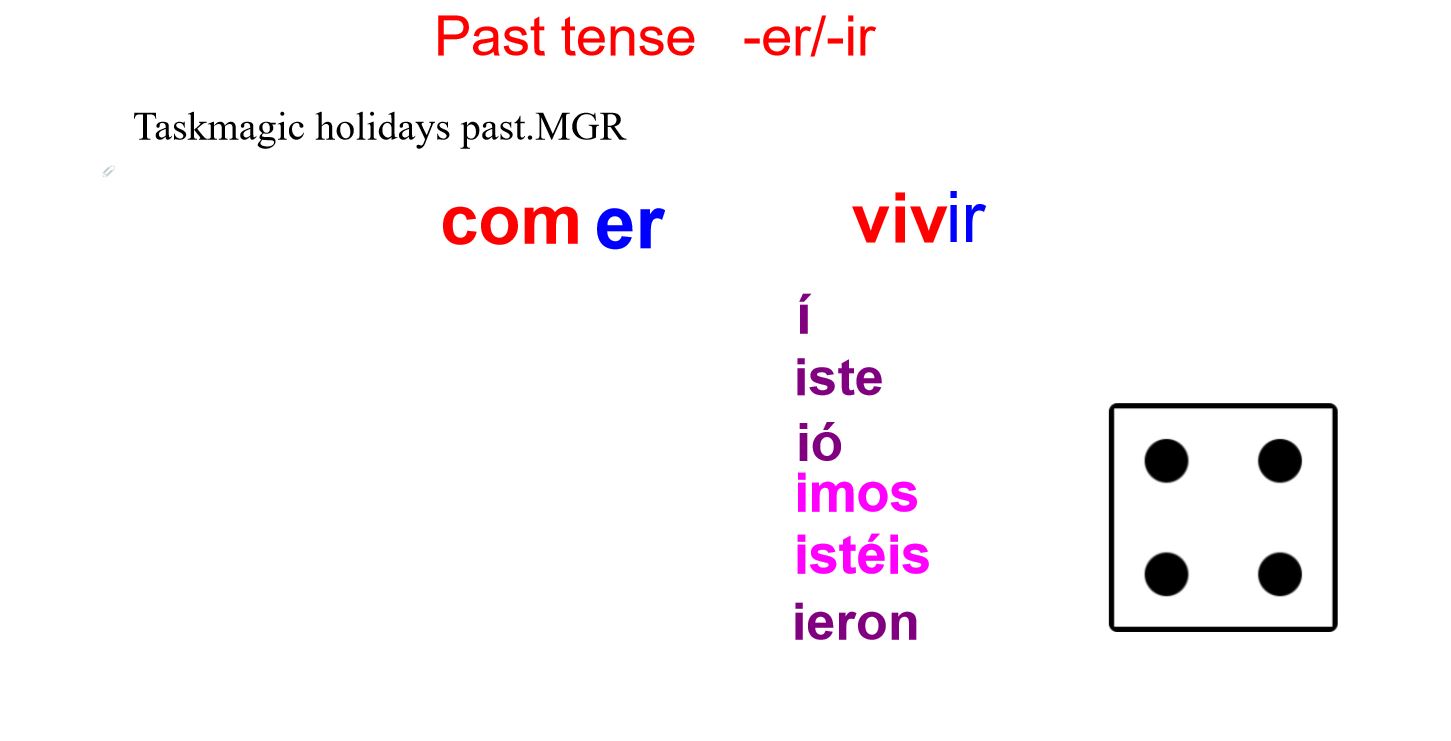
5. At this stage, I explicitly present the different endings and I complement their explanation of how the Past Tense is formed. Students are given the verb endings in a handout at this stage, for the first time after weeks of studying how to describe holidays in the past. With the interactive dice in the Notebook (picture below), we practise conjugating verbs they are familiar with, including ones from different topics.  The Notebook software also allows me to move the different endings around, which is ideal for grammatical explanations.  We focus on AR verbs, first (with low abilities this will take the whole lesson) and ER/IR verbs afterwards. We use the interactive dice to conjugate different infinitives and check for understanding. I do this, with low ability groups, via mini whiteboards or orally with high flyers.


6. We drill the endings! How? using Taskmagic! But you could use Flippity, Textivate or The Language Gym. The VerbGrid Mode in TaskMagic is perfect for this. I use the flashcard mode or this particular game to be played in 2 teams (connect 4) , orally:


7. We drill the past tense in full sentences not in isolation, modified from the Sentence Builders students have been learning, but now referring to my parent and I, my friends etc... To drill this, I use, again, the activities explained in my previous post but incorporating all persons. 

This 7 staged sequence does not take place in one lesson!  It would be impossible, but in several, as many as needed! Reading and Listening activities need to be incorporated too in the picture before stage 7 and after, for students really assimilate the grammatical structures.

The use of memory hooks, as Steve Smith call them to remember the different grammatical rules is key too!  For example, ABBA plays mama mÍA for endings in the imperfect, all my friends were called -ARON for the third person plural in the preterite. Similarly, looking at patterns is also extremely useful and a must: the fourth person in Spanish always has a "m" etc.. 

Over the years, I found this approach works!  High ability kids will conjugate verbs nicely and less able students are aware of the concept and can conjugate at least two more forms apart from the first person, which they can reproduce fluently, while recognising the other forms.  However, this will require constant revisiting: interleaving. 

A lexicogrammar approach, then, despite what some people argue, incorporate the teaching of grammar! and the analysis of  metalanguage.  The key is when this takes place and how! Rather than in isolation at the beginning of the teaching sequence it is taught as part of a whole continuum, at the last stage of learning, thoroughly planned and executed, allowing students to manipulate the language and start moving away from the sentence builders. By doing this, students do. It feel overwhelmed by the grammar but embrace it in the EUREKA EFFECT!


Creating a language lab for KS3 students without a language lab room: INDEPENDENT LISTENING PRACTICE

Tomorrow, 1st June,  the last 6-7 weeks of the summer term start. This year, my trust has implemented a new system where the September timet...