Showing posts with label sequence. Show all posts

Sunday, 18 May 2025

New GCSE Y10: Sequencing our Curriculum Map and access to new Teaching Resources

Like everyone in England, I have spent this academic year revamping our department Curriculum Map and Learning Journey to reflect the demands of the new GCSE.  I viewed the whole process as an opportunity to revise not only our curriculum for KS4 but also for KS3, while we redesigned new and more up-to-date teaching and learning resources for our Y10 students. 

At Princes Risborough School, we follow AQA. I do not like relying on textbooks for the delivery of lessons, but as this was a new syllabus, we decided to choose a textbook, which we could use to mainly, for reading and listening purposes. We went for the Pearson's textbook for AQA. 

Next step was to design our new curriculum for KS4 without depending on the structure of a given textbook, neither on the order of themes as per the AQA syllabus. In order to decide our curriculum map, it was important to think about our own school’s context, the depth of topics covered at KS3 so that we could determine a sequence of topics that would best suit our students, not the textbook or the AQA syllabus. This sequence may well be very different for another school.

The Sequence

In our case we decided to teach:

Term 1: Technology and Free Time + Assessment 1

Term 2: Celebrities and Holidays/Tourism

Term 3: Family/Relationships + big input on the oral exam and End of Year Exam 

It is worth mentioning that we started teaching the GCSE course after May half term when our Y10 students were still in Y9, as students at Insignis Academy Trust, get a new timetable and start their GCSE choice subjects in the last 6/7 weeks of the Summer term. 

During these 6/7 weeks, we covered the topic of Festivals with a big emphasis on La Tomatina as our star festival. 

Why this sequence?

As I mentioned the topics were driven by our school context and our KS3 Curriculum Map, to ensure progression. In Y9 students had been studying, mainly, the topics of Holidays and Tourism, so we felt that it would be great to start Y10 with something completely new to move away from fatigue. 

Throughout KS3, all topics covered, referred to talking about myself, so we thought it would be nice to start the GCSE course in Y9, following the pattern of holidays but in relation to a festival that students attended or would like to attend and which would require them to describe what people normally do there, moving away from "myself" and focussing on third persons: People tend to....

Following the pattern of talking about myself but starting to describe what others do, starting Y10 with the topic of technology was a good choice: it needed substantial new vocabulary while still being loyal to our 5 Magic Powers of key structures and will allow students to talk about themselves but also about third persons: technology can.... technology could...

The topic Free time really followed the path led by Technology, but it would require going back to talking about myself, the topic was also extensively covered in Y8, so we could start getting pace. 

After talking and understanding information about hobbies, learning about Celebrities made sense: a topic which, again, allowed us to move away from the myself realm and focus on another people achievements: the celebrities in different tenses.

Finally, after Celebrities, it made sense to go back to Holidays and Tourism and revisit all the vocab/structures learned during Y9; to finish Y10 with the topic of Family, revising key vocab learned in Y7, and take such vocab to a new dimension, as students could use previous  vocab in new contexts, to express a special occasion celebrated as a family, or activities they do together as a family, or what their family members had achieved, revisiting the vocab of Celebrities in a new context. 

I believe this Curriculum Map has worked for us. 

We have created two documents to go with the curriculum map:

A vocab/sentence builder booklet for students: 

An oral booklet based on the sample material published by AQA. 

GCSE Oral Booklet 

To access SoWs and curriculum maps for the new GCSE, click here

To access all our Teaching and Learning slides, following the sentence builders in the booklet and our SoW, click here. 

I created a Teaching & Learning Sequence for each topic, comprising around 50/60 slides per topic, with Listening, Reading and Oral material incorporated in the sequence. Writing tasks and materials created for our independent, listening lessons, once every two weeks, are not in the sequence. 

Curriculum Maps will change from school to school as they take into account the progression from KS3, the school context and the need to revisit vocabulary in different contexts. 

What is your curriculum map for KS4? Why have you chosen to teach a specific sequence of topics in a particular order? 

Tuesday, 21 July 2020

Inductive Grammar: the Eureka effect!

At the last stage of the learning journey, after modelling and lots of practice (from input to output) of our Sentence Builders structures, I teach grammar.  However, I do not do it explicitly to start with but inductively. Once students have had many lessons, (several weeks) when they have been exposed, via modelling, to such structures, have practised and consequently memorised and learned our Sentence Builders well (where verbs in the I form mainly, but also in the third persons have appeared "casually" in a given tense), I show them a text featuring that particular tense or grammatical rule. 

By then, students can fluently talk and write about themselves and another person in the present, past or future about a particular topic, and because I have planted the seed for the use of a particular tense and most sophisticated language: “ojalá mi madre fuera”, understanding grammatical rules at this stage is easy and enjoyable for the students as they infer the rules to manipulate our sentence builders and start building their own content. It is the Eureka effect when grammar is welcome and embraced! 

This is the process I use, for example, to teach the Preterite Tense in Spanish with a Y8 mixed ability class, after a few weeks (between 3-6) carrying out tasks at modelling,  production and fluency stages, so everyone can talk about a past holiday in the I form, providing reasons and using some nice expressions: si tuviera la oportunidad me gustaría/ siempre he querido ir a or puede ser.

1. Students read a text with structures from our Sentence Builder but now including all the verb paradigms in the past for ar/er/ir verbs. (I always teach the verb IR in the past first, using this method the previous week). In this text I colour code the verbs I want them to focus on. With a high ability group this may not be necessary. I put them in context "El año pasado" and what we will be expecting! As they already know the first person well. Questioning here is vital! What tense we will find in the text? why? Which coloured words do you recognise? etc.. 


2. Working in pairs or groups, students try, first, to find out what the different colours mean prompted by me. What do green/blue/red verbs have in common?  Remember students have already been exposed to and know well,  the infinitive form of these verbs (Me gusta + infinitive) and the I/he forms.  Given students thinking time and clues accordingly, independently of their linguistic level, they always induce that red verbs are -ar  and green -er verbs.  Very good groups will also induce that the green verbs include -ir verbs and blue are irregular. This is great metalanguage talk! 

3. Once the reason for different colours has been established and everyone agrees that this is the past tense in Spanish, students are invited to induce in groups/pairs what is the rule.  At this stage, I may revise the endings for the present tense and remind them about endings in Spanish.

4. Students write down in mini white board their rules and the endings they could induce and we have a plenary session where all groups expose their ideas.

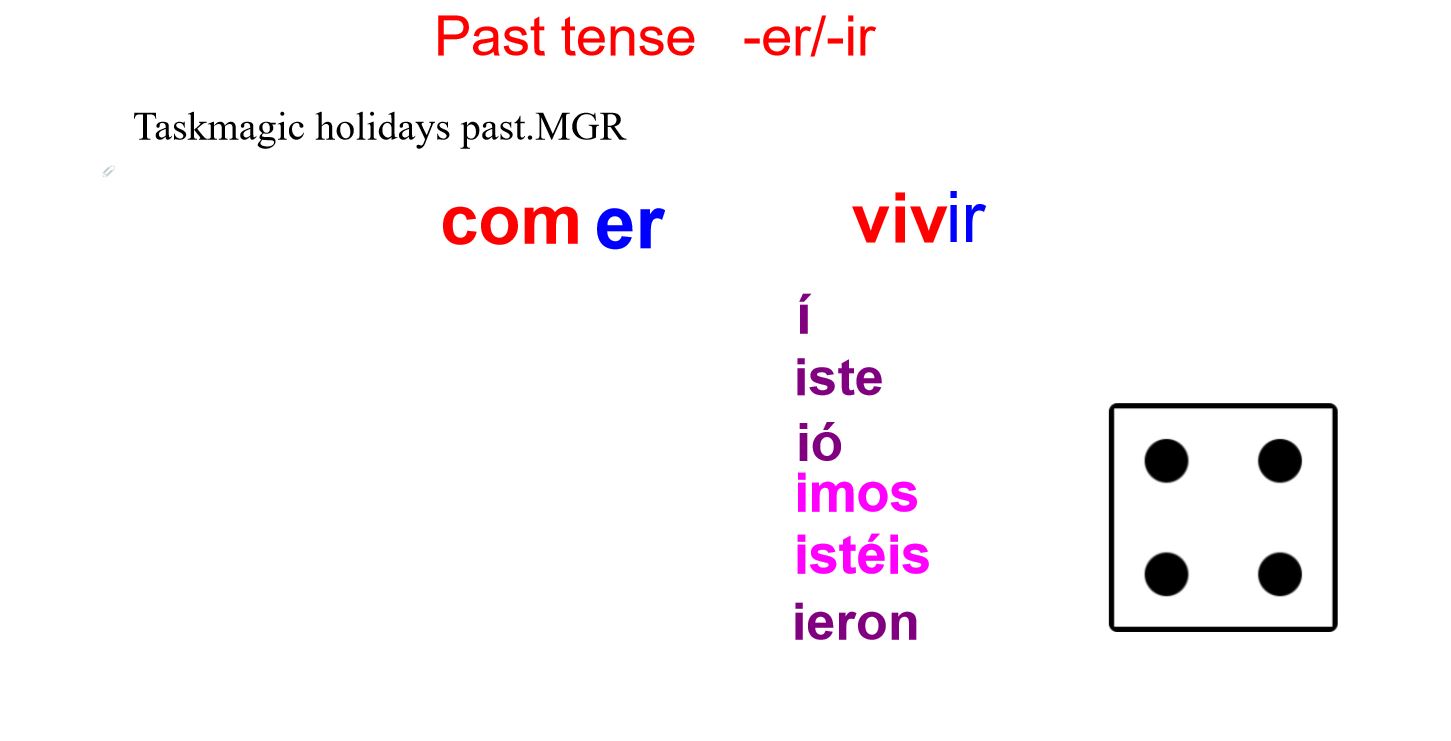
5. At this stage, I explicitly present the different endings and I complement their explanation of how the Past Tense is formed. Students are given the verb endings in a handout at this stage, for the first time after weeks of studying how to describe holidays in the past. With the interactive dice in the Notebook (picture below), we practise conjugating verbs they are familiar with, including ones from different topics.  The Notebook software also allows me to move the different endings around, which is ideal for grammatical explanations.  We focus on AR verbs, first (with low abilities this will take the whole lesson) and ER/IR verbs afterwards. We use the interactive dice to conjugate different infinitives and check for understanding. I do this, with low ability groups, via mini whiteboards or orally with high flyers.


6. We drill the endings! How? using Taskmagic! But you could use Flippity, Textivate or The Language Gym. The VerbGrid Mode in TaskMagic is perfect for this. I use the flashcard mode or this particular game to be played in 2 teams (connect 4) , orally:


7. We drill the past tense in full sentences not in isolation, modified from the Sentence Builders students have been learning, but now referring to my parent and I, my friends etc... To drill this, I use, again, the activities explained in my previous post but incorporating all persons. 

This 7 staged sequence does not take place in one lesson!  It would be impossible, but in several, as many as needed! Reading and Listening activities need to be incorporated too in the picture before stage 7 and after, for students really assimilate the grammatical structures.

The use of memory hooks, as Steve Smith call them to remember the different grammatical rules is key too!  For example, ABBA plays mama mÍA for endings in the imperfect, all my friends were called -ARON for the third person plural in the preterite. Similarly, looking at patterns is also extremely useful and a must: the fourth person in Spanish always has a "m" etc.. 

Over the years, I found this approach works!  High ability kids will conjugate verbs nicely and less able students are aware of the concept and can conjugate at least two more forms apart from the first person, which they can reproduce fluently, while recognising the other forms.  However, this will require constant revisiting: interleaving. 

A lexicogrammar approach, then, despite what some people argue, incorporate the teaching of grammar! and the analysis of  metalanguage.  The key is when this takes place and how! Rather than in isolation at the beginning of the teaching sequence it is taught as part of a whole continuum, at the last stage of learning, thoroughly planned and executed, allowing students to manipulate the language and start moving away from the sentence builders. By doing this, students do. It feel overwhelmed by the grammar but embrace it in the EUREKA EFFECT!


Beyond the Red Pen: Adaptive teaching in MFL as a tool to reduce "formal" marking

Happy belated Easter! As the end of the Easter holidays approaches, I want to reflect on the power of adaptive teaching and how, when it is ...