Showing posts sorted by relevance for query project based. Sort by date Show all posts

Tuesday, 25 August 2020

The power of culture: project based learning in MFL

Two of the criticisms I see on social media about the use of Sentence Builders, is that students just learn chunks of language, without being taught how to manipulate these in preparation for a GCSE exam (parrot effect) and the fact that there is not culture incorporated into the lessons leading to a loss of motivation and disengagement from learners. This last assumption also estates that activities are narrow minded and do not lead to creative project based learning.

On a previous post I explained how Grammar and language manipulation was key for students to become spontaneous and autonomous. The difference in this approach is when the necessary explicit grammatical rules are tackled: after routinalisation of Sentence Builders, not in isolation with single vocabulary items.

On this post I will show how culture and project based learning can also be incorporated in lessons using this methodology. The key is that students need to be trained fully, via Sentence Builders, on how to tackle a creative project involving culture if we do not want them to resort to Google Translate! Let's face it, with the little curriculum time dedicated to MFL, the learning process is slow and students, especially at KS3, do not have proficiency required to carry out creative projects which rely on sophisticated use of language, unless we explicitly teach it!  In fact this ability does not occur naturally until the end of KS4 and throughout KS5 for the most able learners. 

Does this mean we cannot use culture and project based learning in MFL? Of course not! The beauty of learning a language is learning about the culture and project based learning is perfect for this. The key is how we plan and structured this task. 

This is our structure for cultural and project based learning in Spanish:

Year 7 

At the end of term 1, under the topic of family and descriptions we do teach a module on Picasso and Miró. We teach students more sophisticated vocab such as figura estrellada or the present tense continuous to describe what is happening in an image. Students use this new Sentence Builders to describe real Picasso and Miró pictures. They do this, first in writing, and secondly orally, using Flipgrid, Thinglink or Onenote to insert audio on a particular picture. Finally, students, in conjunction with the art department, will create their own Miró/Picasso drawing which they describe orally and in writing using the previous apps. QR codes are finally created on their outcomes, which we display in our talking wall. This module also allows teachers to introduce Spanish art to students.

Smartboard materials to teach a Miró and Picasso module

Powerpoint Sentence Builders on Miró shared by J Santos on our MFLtwitterati Padlet

Powerpoint Sentence Builders on Matisse shared by Ruth Hedley 

Year 8

Y8 traditionally take part in a eTwinning project with our partners schools in Spain and France. Our last project consisted in the collaborative creation of a touristic guide which included emblematic cities in the UK, Spain and France. Students prepared presentations, using Google Slides on different cities in the target language and would work collaborative, via Google Slides with students in all involved countries. The language was definitely more challenging here, but, still was studied via Sentence Builders during lessons prior the project. The beauty of this project, as you can see in the link below, is that we carried out many other activities involving real language exchange with our partners: real communication in the MFL classroom.

Rutas Molonas eTwinning project with Spain and France

eTwinning is a great tool run by the British Council which allows teachers to look for partners and/or register a project for which you get an online space/platform (your twinspace) making your project look super professional! See the example above. Most interestingly, projects get recognised by the BC with certificates (great CPD opportunity). There's also the possibility to be awarded a Quality Label for outstanding projects! Finally, from all the projects obtaining a Quality Label, 10 will get a National Prize, which is a great achievement and wonderful recognition for the MFL department and students alike!

How to plan a successful eTwinning project?

Keep it simple!  You can develop simple projects linked to your SoWs so that when a topic is covered, students have the opportunity to do something meaningful and creative with a real audience!  Describing each partners' schools, cities, families in the target language and create a collaborative ebook, via Thinglink or just Padlet, has proven very successful in the past.  These activities do not require a lot of planning and the impact is great! 

Another simple project I conducted was based on the creation of real listening and reading materials from both schools, ours in English and our partner school in Spanish, which we would exploit as authentic resources in the classroom. To plan this, we created resources on the topic covered by each partner school. It was great to receive videos from our partners talking about their family members, when doing this topic, which we could exploit as listening activities and followed up with videos my students' own Spanish videos!  So keep it simple! A pen-pal structure to your project is also a good idea so for Xmas, independently of the project, students would get/write Xmas cards, for example  I always pair (different nationality) students taking part in the project so that these do keep real communication throughout! If you do a project linked to a physical exchange, then, the whole project and the forged relationships take shape and it all becomes something really special. 

eTwinning also has project tool kits to get you inspired!

Year 9

Y9 students study the topic of Media during the second term so in the past we have carried out a project on the film Voces Inocentes. We dedicated around 5/6 weeks to do this in lesson time: after watching the film in two lessons, specific vocabulary to talk about the film was taught via SBs and throughout our normal range of activities. Students carried out translation activities leading to oral/written practice and a creative project where they needed to describe the film and write a review. We got inspiration from Rachel Hawkes' resources on the use of film for this one!

Smartboard Voces inocentes teaching materials

This year, we are changing the film to Coco. Watch this space for resources!

Less able pupils, instead of carrying out a specific film project, completed a booklet based on different Spanish short films. This was a success! 

Short Film Booklet 

In the summer term, Y9 students study the topic of healthy living and food. This is a brilliant opportunity for students to cook some Spanish food. 

This year, during lock down we run a Masterchef cooking competition on making Palmeritas. Students first learned specific Sentence Builders on giving cooking instructions and practised the vocabulary via a demonstration video filmed by me cooking Palmeritas. After some practice, students needed to cook their own Palmeritas while giving oral instructions and filming the process. Finally videos got shared on a Padlet and winners were chosen. 


The Language Challenge embedded in the curriculum

Single linguists in Year 9, dedicate a MFL lesson out of four, to complete the Language Challenge.  This is an award run by Routes into Languages which encourages students to research and learn about the culture of the language they study. Most of this independent research, guided by their teacher, will be done in English. Students need to complete a series of tasks which translate into points aiming to reach 100 points, when they get awarded the Language Challenge. In practice, single linguists dedicate 3 lessons to language learning and one lesson to research based culture learning. The benefits are great: independent, self-motivated students who take ownership for their learning and become more motivated to learn the language.

Year 10

Y10 students and some able Y9s also take part in our Erasmus language programmes every other year. Erasmus, despite requiring a lot of work via the application process, management of grants etc, is a fantastic way to promote languages and embed project based learning in the curriculum. Students work collaboratively with partners in La Reunion and Spain on a particular project using e-Twinning as our working platform. Erasmus also include mobilities, which in Erasmus jargon just means an exchange funded by the Erasmus grant! 

Our last Erasmus project,United in diversity,  based on heritage and festivals in Spain, La Reunion and the UK involved 78 students working collaboratively and was such a huge success!  Students worked in multinational teams throughout a year, which allowed them to develop real relationships!  They even participated, as part of our project into the Spanish carnival (those were the times!). Linguistically, all students improved massively and culturally the project was a blast! We even won a National Prize for our etwinning/Erasmus platform.

United in Diversity: an erasmus project

Viva el Carnaval! footage

Forging relationships!


Feedback from parents on our Erasmus project


Teaching via Sentence Builders and teaching culture via project based learning are not incompatible, rather they complement each other. The MFL teacher must teach experiences not just the language!


Sunday, 11 October 2020

Tackling Writing, the interwoven skill: from KS3 to the GCSE exam

On this post I am going to focus on the skill of writing and how to develop accuracy as well as content and rich language. All key elements of the GCSE writing mark scheme. 

Writing is even more important this year as the oral exam, as such, is not going to take place, so on its own, this skill will hold 33% of the total GCSE mark.

Writing is intrinsically linked to accuracy, use of grammar and translation skills. Writing can support oral skills beautifully, as the content is the same for both exams. This is even more the case in Spanish and German as they are phonetic languages, so both skills truly correlate. Writing is also core for retrieval practice and a key tool to memorise vocabulary in many students. In other words, writing is the interwoven skill which underpins many others!


Below you can find some of my favourite techniques to practise writing and tackle accuracy and rich vocabulary use as from Y7!

Writing as a stickability, learning tool!

Any structure or key vocabulary that we want our students to embed in their long term memory, can be practised via writing. After introducing Sentence Builders, doing listening and reading tasks, before moving to controlled production via oral activities, I always plan writing tasks to help my students memorise key structures. 

1. Writing short sentences with mini whiteboards via Dictations

This technique is great for modelling and extremely powerful to practise key structures from current and previous topics. It means modelling via listening and writing at its best! Dictations are also great to train students' brain to recognise the link between phonemes and graphemes. As a teacher, in its simplest form,  I dictate  a sentence in Spanish and students write it down using mini whiteboards. Delayed Dictation is great here too for memory retention! Dictation in pairs works great too. 

2.Writing short sentences with mini whiteboards via short translations.

Same as above but I say sentences in English, based on our SBs, and students translate them into Spanish. Students get immediate feedback and the activity can lead to meta linguistic discussions with students, which they love: why this verb must end in a and not ar? Why la gasolina es caro would be wrong? How would we say it makes us feel good if we know me hace sentir bien means it makes me feel good?

To make it more interactive, I use small incentives: every three correct translations students get a sticker. Students keep a tally in their Onenotes and 15 stickers equals an Alpha. (Our school reward system). 

To make the process even more fun, I use taskmagic flashcards with pre thought key sentences showing initials in Spanish for support for less able students. 


Also, wheel of names works fantastically well this way and adds to the unpredictability aspect. I spin the wheels and students need to translate the sentence that both wheels show in English.


The randomiser activity in Flippity is also an invaluable tool for this technique. I click on the lever and students translate, using their mini whiteboards, the combinations showing. Vincent Everett and Mike Elliot use the randomiser for reading and oral practice too, in combination with Flipgrid. 


After one lesson practising controlled writing in this way we move to controlled oral practice using the same sentences but now to be carried out orally, instead of using mini whiteboards. This helps tremendously with fluency! 

3. The Random Name Picker feature in Flippity 

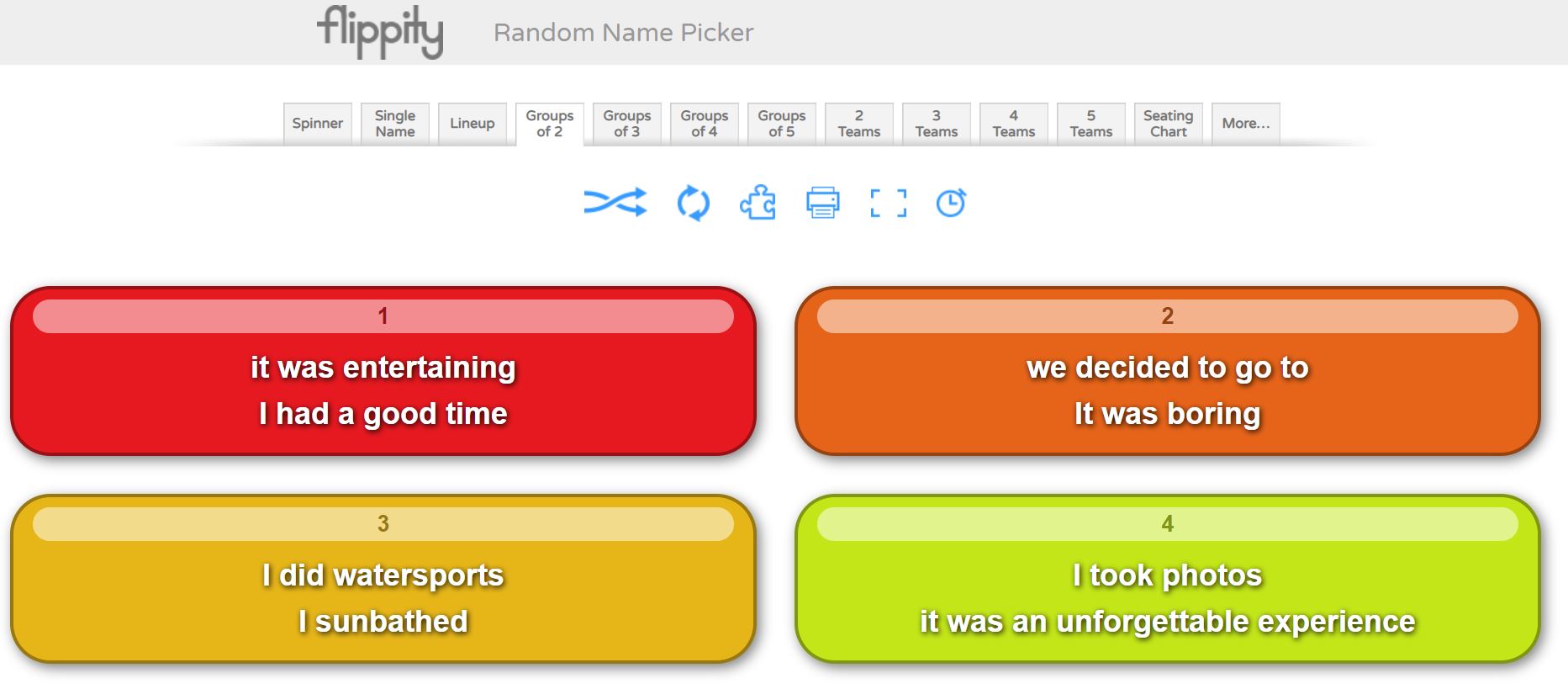
I have already talked about the Randomiser activity in Flippity. The  Random Name Picker activity is also very powerful if used with key vocab instead of names! You can choose, a spinner (similar to wheel of names) but also Group of two, three, four of five! These modalities create boxes with  two, three, four or five of the structures that you previously inserted. See example below.

As an initial activity, I ask students to write a long sentence using the structures within box 1. To make it more challenging, I ask students to write a paragraph using boxes 1, 2 and 3, in lessons they do this with mini whiteboards. This is a very powerful and fun activity which will test the creativity of students and will move them away from mere translation tasks. As homework, this is also a great task.


4. Writing short sentences and paragraphs via Quizizz

I love Quizizz! It allows me to create my own quizzes and tests for retrieval practice and to practise writing skills! 

The modalities of Fill in the blank, where sentences in English have to be translated into Spanish, with immediate feedback for students and Open Ended, are my favourite! For the Open Ended modality, I write a bullet point in the style of the 90 words GCSE writing exam, I set the quiz for 5 minutes maximum per question, and they write down a paragraph covering the bullet point showing in the question in that time. It looks like this from the student's point of view:


This type of activity is very powerful after carrying out mini whiteboards tasks, and a Fill in the blank quiz. I would expect students to recall information from memory only, to do this. Students know that for each bullet point, the quiz consists of a maximum of 5 bullet points, they need to cover the point, give a justification and an opinion and make reference two at least two tenses. This would have been practised endlessly in my model sentences. 

5. Writing pyramids 

This technique has been inspired by Gianfranco Conti. It can be carried orally or in writing. Students work in pairs with mini whiteboards. I give them two writing pyramids in English, A and B, starting with a structure at the top and finishing with a short paragraph at the bottom of the pyramid. See example below.


Each student also gets their partner’s Spanish version of the pyramid. Student A starts translating the pyramid in their mini whiteboard and student B makes sure it is correct, if a mistake is made, student A must stop and wipe their board. Student B has a go with their pyramid, then, and student A checks that no mistake is made. When a mistake is made, student A starts translating again. Every time a student takes a turn, they must start from the top! This reinforces key structures, grammar and use of accents!

6. Tangled Translations

Students translate a paragraph into Spanish but the original text will be partly in English, partly in Spanish! 

7.  One pen one dice

The classic translation game! Students work in pairs. Student A starts translating a given text while student B, using a digital dice these days, rolls a dice until they get a 6. When they get a , student A must stop translating and student B starts doing it while student A rolls the dice. I tend to do this activity for about 10 minutes for fun and after that I just tell the students they must work on their own and translate the text freely. My experience is that otherwise, pupils may get extremely frustrated and give up!

A link to a digital dice can be found here

I love Vincent Everett suggestion of using this activity for students to make short sentences from their Sentence Builders, orally or in writing. This way, students make as many sentences as possible from a given Sentence Builder sheet, until their partner gets a 6. 

8. Running Dictation

This is a fun dictation activity in pairs! Students work in pairs. Texts in Spanish are placed around the room. Student A runs to their text, reads it, tries to memorise the information and runs to student B to whom they dictate what they memorised. Student B writes the information down. At the end, students check their written version to that of the text. It provides a great model example which can lead to reading and grammatical analysis of the text. 

9. Dictogloss

This is another multi skill-activity, incorporating, listening, reading, speaking and writing. I like doing this activity with two texts A/B. In pairs, students first work through text A and then text B, which are very similar!

1. Student A reads text A and writes a summary in English. Student B reads text B and writes a summary in English too.

2. Student A, using their notes in English must translate the text into Spanish to their partner who listens and transcribes in target language.

3. Student B completes step 2 with Text B

4. Both students compare their transcription with the original texts.  

10. Battleships 

I create a battleships grid which we have previously worked with for listening and speaking. As a writing task, I give students 15 or 20 coordinates and students write the sentences corresponding to these.  B1, B5, C5 etc.. 

Again, an extremely easy and versatile activity which really reinforces the grammatical and vocabulary structures that I want students to focus on. For high ability students, I ask my pupils to extend the sentences.


11. Four boxes

I learned about this activity from FaceBook, sorry as I do not remember from whom, and I love it as it does not require any preparation. I display four boxes in my screen and ask students to translate a given sentence using their mini whiteboards, after all show their mini whiteboards I ask for a volunteer to read their sentence, if it is correct I write their name in one of the boxes. I repeat the process four times, so all four boxes are filled in with a name. The fifth time, the volunteer student needs to choose one name in the box to be kicked out so that their name can be written in box instead. After some time, say 20 minutes, the four names in the four boxes win!  Students love this game and become extremely competitive. It works even better orally!  I use it in conjunction with TaskMagic or Flippity Randomiser. Mind that you need to know your students well and the relationships in the groups must be good. If you have a digital timer that students do not see, it makes the experience unpredictable and more fun. Thanks Vincent Everett for the tip! 

12. Slalom/Translation writing activities 

Another Gianfranco Conti activity, which he suggested that I added to this repertoire and which I have used on some occasions too. The idea is to present students with a grid of chunks in English or Target Language, which they need to manipulate to create their own paragraphs. With low ability students I find it is best to give them a list of sentences or a short paragraph in English for them to translate by combining the different chunks. High ability sets love creating their own paragraphs or sentences, these students will also benefit from being encouraged to use other language, apart from that in the grid, which promotes language manipulation. 

13. Editing writing tasks

Another suggestion from Gianfranco Conti to this blogpost. It’s simple! Just provide a model writing task and ask students to edit it by changing key words, modifying the tense it is written on, making the writing better by writing reasons and opinions or adding extra tenses! It works well if students are presented with a list of sentences that they need to make into a whole paragraph. Great if it is done like a competition in a collaborative way in teams: which team can write the best paragraph based on these sentences? Students can share their writings using Padlet and learn from each other's answers. 

Writing Tasks with Checklists

When handing out a writing task, I always include a check list to help students in the writing process: use reasons, use opinions, use at least three tenses, use key high impact expressions, use vocabulary from past readings and listenings. 


Use of sentence builders and random vocab

These are great for writing and students should know them really well as all of my SBs are linked to a specific quizlet course! However, I also make students create their own quizlet set with random vocab found in listening and reading tasks, which they must learn! 

When carrying out writing tasks, I expect them to use their SBs but also at least three expressions from their own personal random Quizlet. This improves their use of language massively if required to do in all longer Writing tasks!

I also practise this random vocab in conjunction with flippity: create a sentence with box one and two expressions from your random quizlet course. This works really well with high ability students.

Creative and Collaborative writing: Project based tasks

Once students have practised the language in the controlled, production stage of learning, via many translations and small creative paragraphs, they should be ready to write on their own following some guidelines.  At this point, project based tasks to be carried out individually or collaboratively with partners can be very motivating. If these tasks are part of a project with students in another country via eTwinning you have a winner!  For these type of assignments I tend to use Padlet or Google Slides. These projects tend to be carried out towards the end of a topic and are common practice at KS3, unfortunately much more difficult to fit at GCSE level!

1. Y7 Art Project on Miró and Picasso

This project includes Writing and Oral tasks, as well as creating your own Miró styled work of art. For full details and materials for the project, visit my post, The power of Culture, here. Scroll down until you find the Y7 project. 

2. Y8 etwinning project 

Rutas Molonas, a project designed to write about student's own regions.  This is done with our partner schools in France and Spain. Information on the project, can be found in my post, The power of Culture, here. Scroll down until you find the Y8 project.

3. Y9 cinema project

So far we have studied Voces Inocentes but this year we are going to study Coco. We will dedicate the whole Easter term to study different topics through the film with the intention of creating a Coco Film online book display on the film. Watch this space, as I will dedicate a post to the project and all the materials used for its delivery.

4. Y10 exchange experience project

In Y9 and Y10 students are given the opportunity to participate in a exchange. As part of their experience, students, in conjunction with their partners in Spain need to create a blog diary, using Padlet, of their experience there. This is collaborative and creative writing tangled as one and the results can be awesome!

How to tackle the second writing task in the GCSE exam

To prepare my students for that second task, I do all the above activities but also in Y11, every two weeks, we do a Timed Writing Task. Students are presented with a Writing Task sheet, see below.

Writing Task two Titles for GCSE

Every two weeks, for homework, students must prepare a task from the list above, which I select. I start with writing tasks incorporating topics from Y10. Students prepare their writing and during our lesson they write 150 words in 40 minutes from memory, only having the two bullet points in front of them for support. I start this process, every year, after Half-Term in October and we continue it until study leave. It works wonders as we recycle all writing tasks. 

I mark these writings using the AQA GCSE mark scheme. I highlight careless mistakes, which they must correct or add to, if not enough opinions given for example, as part of a second homework. 

Make the link between the General Conversation in the Speaking exam and the Writing exam

If, as part of homework students need to practise their oral questions for the speaking exam, make the next writing linked to the same theme/topic as this oral task. There’s a clear link between both exams and students need to understand such link!

They must realise that by revising potential oral questions for the general conversation they are, in fact, learning potential content for the writing tasks. Understanding this link breaks down the gigantic task of preparing four separate exams and the GCSE preparation, becomes a more topic based exercise: same structures to be used in four different ways! Such concept is also reinforced by using multi skilled activities and the same type tasks to practise different skills, for example Battleships for listening, oral and writing. Students must understand that all skills are interwoven and must be practised interlinked with each other.


Thursday, 15 July 2021

Lights, Camera, Action! Empowering the curriculum

This post has been inspired by the talented Isabelle Jones who asked in Twitter which Spanish films teachers integrated as part of SoW at KS3. She made me think of film in the MFL classroom, which can be such a powerful cultural tool to motivate students, learn culture, values and of course language! 

However, like any task/activity, it must be very well thought out and truly embedded in the curriculum. I am not keen of watching films, for the sake of it, but planning to watch and study a film while taking the opportunity to exploit it and embed it into the curriculum. 

How to integrate films into the curriculum 

When planning a unit based on a film, I think of three pillars: the planned final discourse, cultural outcome and linguistic/grammatical exploitation.

Pillar one: the final discourse

Firstly, like with any other unit, plan the discourse which you would like your students to produce, linguistically, after watching the film. For me, in most cases, regardless of the linguistic level of my students, this discourse is to be able to tell what happened in the film and give opinions about it as well as recommendations. 

As with any work unit, I need to define the exact final outcome/discourse that students will have to produce and work backwards thinking of activities to get them there. For that purpose, I create a Sentence Builder with this language which will be the backbone of the whole film unit. See this link to see the Sentence Builder I created for Coco this year for our Y9 classes.

Pillar two: the cultural dimension

However, a film is richer than that! So, also think about the cultural dimension and what you would like students to learn culturally from any given film. In this category we can also include values or international issues promoted by the film:

Coco for example, is great to explore the Day of the Dead in Mexico and the Aztec culture.

Voces inocentes is a fantastic opportunity to talk and debate about children in war, the power of friendship and children soldiers. It is also a good film to learn about differences between poor and richer countries and immigration. 

Cuerdas is a fab example to talk about diversity. 

Zipi y Zape it’s great to talk about values such as friendship, family and the world of comics in Spanish speaking countries. In fact, it could be twinned with a Zipi Zape comic story and it could lead to the Argentinian comic Mafalda. 

I always conduct these debates and research in English.  

Pillar three: exploiting the language

Finally, the last pillar to consider when planning a unit based on a film, is the language (vocabulary and grammar) which I would like to explicitly teach and to practise from the film. For this, I use extracts from the film to be analysed linguistically with specific activities, to move later, to practise such structures in different contexts.

This pillar is normally integrated with the first one, as I would like students, to learn such structure and use it in their final discourse and it is included as a seed planting experience in the original Sentence Builder. 

Planning/creating the tasks

I then start planning the different activities to tackle these three objectives. Another strategy I use when exploiting a film, is to make it clear to students that they will need to create a project on the film, so there is a clear product for them linked to the final discourse. I turn this into a competition! 

The project, tends to be a big poster where students write or talk, using a QR codes, on what happens in the film and a recommendation ( basically a review, based on our original sentence builder) and a section on the cultural/international/geographic aspect that we debated in lessons, written in English. All must be illustrated with pictures, etc.. promoting the artistic vein of my students! Normally, I give a choice of format to create this final project: poster by hand, a video, a digital infographic, a physical/digital book etc.. so there’s something for everyone! 

However, for the film to be embedded nicely into the curriculum, pillar one is key! To develop this, I apply the same T&L  strategies I do on any topic. For me these are based on the Lexicogrammar or EPI approach, by Gianfranco Conti.

I exploit the original, planned Sentence Builder, after watching the film, by doing lots of listening and reading tasks on the content of such Sentence Builder (Modelling phase), such as dictations, mini white board activities and quizlets/Memrise for students to learn the key vocabulary. 

I then move into Structured Practice with many of Gianfranco classic activities: pyramid translations, oral ping pong, information gap activities, lots of pair work based on practising sentences from our Sentence Builder. For this, I use digital tools such as Genially, wheel of names or LearningApps among others. Grammar is learned/ practised towards the end of this stage. 

Finally, once students know the structures well, we move to developing fluency and manipulating the language with more activities: speed dating, some of the activities from the previous stage but now with open ending questions, leading to students acquiring the language spontaneously and creatively to carry out their final project. 

Once the language is secured and students can narrate events on what happened in the film, we move to the cultural/ value activities on the film, which would have been already pointed out as part of the Sentence Builders but now will be debated and analysed in English. At this stage, I use YouTube videos, online materials and group discussion activities to promote dialogue and debate! 

The whole process normally takes me 6 weeks, basically, half a term.

An example of this process can be found in my resources from Coco. However, these are not fully finalised. Click here.

Students learn the film unit well and I have had many students who use the sentence builders learned at this stage, to describe a film they recently watched as part of their GCSE oral conversation, which shows the impact such films had in students.

Normally we dedicate 6 weeks in Year 9 to a film project, while we use Short Films and Extra episodes with Y7/8.

Favourite Films for Spanish 

Coco
Voces Inocentes
Valentín
Carlitos
Zipi y Zape
Manolito Gafotas 
Campeones 
Tadeo Jones

Short films

If you do not have lots of time, using short films and some follow-up activities, is also a stimulating way to learn the language! Personally, I use short films for Y7/8 and a whole film unit in Y9, as their language is stronger. Have a look at this pack on short films activities we created for my department.  

These are some of my favourite short films:

Cuerdas


La Leyenda del espantapájaros


La Huida

Los Gritones


Finally, oldies like the Extra videos (available in French, German and Spanish), which can be found in YouTube, are great for a relaxed soap time at the end of a busy term or every so often to chill out! Worksheets for the Extra Spanish series can be found here.

Overall, film can really enrich the curriculum, however it is important to be exploited fully and be part of your teaching continuum. 

Saturday, 26 December 2020

Let's teach for the BIG MATCH: Let's keep ERASMUS!

I am a passionate MFL teacher and I love teaching my native language, Spanish, but most, importantly, I am an educator. I influence lives and MFL is a wonderful vehicle  to instil tolerance, cultural awareness and break barriers among my students. MFL helps to educate global, tolerant citizens.

I see my job as a sport coach, say football: my lessons are the training sessions leading to the big football match. What is the big match? Real life experiences that allow students to put what they learn in lessons into practice. My job is to create these experiences! Why? Because we do not tend to remember our training/ coaching sessions, we remember the big real event: the football MATCH.

I believe that my students' big matches are real life situations when they will be required to put their linguistic skills to the test and learn from the experience! How do I create these experiences in the educational context? How to create experiences that are 100% memorable? Via  ERASMUS Plus supported by eTWINNING.

I have been involved in several eTwinning projects over the last 20 years and every single one of them has made a difference in my students AND my teaching.

In 2018, my school and two of our partners in Spain and La Réunion decided to apply for an Erasmus project. It was a one-year project, based on the heritage of our three countries and the teaching of MFL (French, English and Spanish). THE PROJECT WAS OUR SCHOOLS' BIG MATCH AT THE TIME. We did not only learn MFL in our language lessons, but we embedded our project, United in Diversity, in the delivery of such lessons. As a consequence the learning curve, motivation and impact in our students, teachers and parents were phenomenal. WE CREATED MEMORIES, FORGED FRIENDSHIPS, OPENED HORIZONS AND BROKE MISCONCEPTIONS AND BARRIERS! 

See this video footage to see it by yourselves

Or this one!

Or the parents' response to our project


The experience was so positive that we applied for a second project: The Village, which was approved for funding in September. This time a two-year project involving the teaching of the SDGs via MFL.

That's why I was in shock when I heard from our Prime Minister on Xmas Eve that Britain had willingly decided not to take part in the Erasmus scheme anymore as it is too expensive to run for the UK. Instead, he confirmed plans to launch a domestic scheme, the Turing Programme, to help British students to visit universities around the world. 

In my view, this is catastrophic news! We surely cannot duplicate a 34 year old scheme from scratch, on our own, and expect it to be cheaper and at least of the same high calibre that Erasmus is. Referring to the Turing Programme, Boris Johnson was talking about University students, benefiting from visiting the best universities around the world, not just Europe, but let's not forget that Erasmus Plus offers funding for projects involving not only higher education but also vocational education and training, schools, adult education and youth, while providing extra funding for those with disabilities.

Erasmus Plus also offers funding for activities and projects under three Key Actions: Mobility of individuals, Cooperation for innovation and exchange of good practices and Support for Policy Reform.  That is a big umbrella and a lot of projects and actions to benefit from! To emulate this, as effectively, sorry Mr Johnson, would require a monumental effort and capital injection and still we will be 35 years behind what we have achieved so far.

Having the Turing scheme involving, potentially, projects with the whole world, not just Europe, as attractive as it may sound, could not possible deliver the same highly wide range of activities, currently available under the three Key Actions. It seems that Boris Johnson is just focussing on Key Action 1: mobility of individuals and only under the context of higher education.

The concerns raised from a potential British scheme to substitute Erasmus were presented to the Lords Committee back in 2018. This was the summary. Such summary concluded that Erasmus presented good value for money and its strong brand, trusted reputation, and common rulebook for partnership agreements could not be fully replicated by a UK-only programme.  

It is a huge loss! Our British students, who overwhelmingly voted for Remain, are being punished by the system. School aged students will be the biggest victims. The Turing Programme may well, eventually, reach the standards of Erasmus Plus, but it will take years and years to do so. We will be failing our students in the process. We are taking the experience of the big MATCHES OUT OF OUR BRITISH SCHOOLS, especially those schools in the most deprived areas, which depend on the big MATCHES to turn lives around.

Let's act on this. We must spread the word and make a big deal of the situation: WE MUST NOT FAIL OUR SCHOOL STUDENTS, WE MUST TEACH FOR THE BIG MATCH, WHICH IS ALREADY HERE: ERASMUS.

Let's take action: share your Erasmus experience, contact your local paper and MP. Let's fight for the big match!

Sunday, 9 July 2023

Tweaking the Curriculum for the new GCSE

As you know, I am starting a new job in September as Head of MFL in a comprehensive school near Oxford, Princes Risborough School. Talking to my new team, it was obvious that they are super talented and really committed, as well as the SLT, to raise the profile of MFL across the school. MFL is an option at GCSE and we would like more students to choose it as option at the end of Y9!!  

"Languages, a LIFE skill to achieve"

I had a preliminary meeting with my new team in May to establish the priorities of the department using the SWOT analysis diagram:  Strengths, Weaknesses, Opportunities and Threats.  This led the path for our vision: For MFL to become a popular, established choice for students at GCSE with great results and make sure that pupils saw the benefits of learning a new language.  We came out with a Mission Statement that summarised this vision: Languages, a LIFE skill to achieve. This vision/mission statement would drive our curriculum: students should choose MFL for GCSE because it is a LIFE skill and must be learned and nurtured. 

To make the connection between LIFE skill and what happens in the classroom, we agreed that being able to communicate ORALLY at the end of the language journey had to be a must for the students, so our curriculum should be focussed on developing FLUENCY. 

To achieve this, we would use our knowledge of Cognitive Science, the benefits of a Lexicogrammar approach to language learning and applying Rosenshine's Principles to our teaching pedagogy, without forgetting the power of gamifying the curriculum, for real communicative tasks, even when these are just a drilling exercise, part of the learning process and, of course, Project Based Learning, as the reason why a unit will be taught, which will connect what we teach to a purposeful, meaningful, real to life scenario.  At this point we agreed that we would involve our partner school links as much as possible, so that at the end of each taught unit, students would have the opportunity to speak/present what they had learned to a real native audience. 

Tweaking the curriculum: LESS IS MORE and PROJECT BASED LEARNING

Last week we met to actually design a new curriculum for KS3, which would take into consideration all these elements, as well as the elements of our new GCSE for languages. 

Below you can find the presentation I use with my team to give a rationale to our new Curriculum. It was lovely to see that actually, the topics for KS3 would be the same as studied so far! We just had to take into consideration the new vocab lists for AQA/Edexcel and tweak some of the content to make sure that as much of that vocabulary list was learned during KS3.


We also decided that LESS is MORE, so we would teach just a unit/topic per term, to allow time for students to really practise the topic, embed structures, teach grammatical points and be creative with the language to, finally, become fluent in that topic.


5 Magic Powers to help Fluency and Embed Exam Skills

Finally, we agreed to use 5 Magic Powers, our non-negotiables, which would be the common thread across the whole curriculum. I have talked about the 5 Magic Powers before in this blog. I love them, because, not only they are success criteria for productive skills at GCSE level, even with the new GCSE, but they help my students to be able to speak and be fluent, as these powers are so embedded in all our lessons. 

If I ask my students: what do you do in your free time? They will always have something to say: an activity, an opinion, a reason, reported speech sentence, more than one tense and some extremely colloquial and common expressions, high impact expressions as students learn a few formulaic expressions for each power element, throughout the curriculum to be used in any context. By doing this, students not only speak but they embed the elements that will score them points later in their GCSE exam. We teach them to speak and give information and, by default, they will score highly in their exam.  

Finally, let's not forget, that at the end of each unit, students will have the opportunity to put the language (vocabulary, register and grammar) into practise via a real-life situation task: Taking part in little drama sketch performed in assembly, talking to our partner schools on a given topic/presentation, pitching for the best holiday experience to be featured in a digital travel blog, taking part in a film review competition, taking part in a school treasure hunt with the studied topic as the theme for this etc...

The 5 Magic Powers:

  • Using more than one tense
  • Give opinions
  • Give reasons
  • Using Reported Speech
  • Using some idiomatic/high impact expressions, so you sound like a Spaniard/French speaker.

For the Magic Powers to have effect, they will need to be taught and practised constantly, throughout the learning journey at KS3, in all the units: that's why less is more!! Fewer units, more time to learn lexis and grammar and more time to embed skills.

The next step is to create the content for the units: via Sentence Builders, using  the material in textbooks, the new GCSE vocabulary lists and our knowledge of the language as specialists and create a mark scheme to mirror the curriculum. To create our sentence builders we are using the site Sentence Builders, super fast to create + lots of interactive activities to go with them! I will share mine once I create them. 

This is the language journey to share with students.


Saturday, 20 November 2021

Stretching ALL students in MFL, not just High Achievers!

In these post I will be focussing on how to stretch ALL students in the MFL classroom and in the process, any high achievers that you may have, but not exclusively them, especially if like me you use Sentence Builders. I have read lots of comments suggesting that the lexicogrammar approach or EPI, following Gianfranco Conti’s nomenclature, can be boring and not stretch students in lessons, especially those with a higher aptitude for languages.


Anchor in Challenge

I have experienced the opposite. ALL my students, including  highly motivated students with an aptitude to language learning, can actually fly using this approach. The reason why is that from a very early stage we plant the seed for more sophisticated structures, which nurtures my students' curiosity and makes them explore grammatical concepts earlier and start being creative with the language. Sentence Builders allows me to Anchor in Challenge.

How to stretch students

Curriculum Design

Make sure you design a good curriculum which allows for creativity and the exploration of grammatical concepts early on. 
On one hand, your students will feel special, clever as you point out that some of the structures they are learning are 7-9 grade structures, you are telling them that you BELIEVE  IN THEM and they CAN ACHIEVE. 
On the other, High achievers tend to love finding out how the language works and planting the seed to interesting grammatical structures is key to make them expore!

For example, our Sentence Builders in Y7 incorporates the structure me gustaría que mi madre fuera + personality adjective  (I would like my mother to be), which in Spanish would require the use of the Imperfect Subjunctive. 
ALL our students, independently of ability, can recognise and/or use this structure and they feel good! On top of that, high achievers are prompted to work out how we would say I would like my parents to be which would require them to use fueran (3rd person plural), which they often decode after applying the pattern from “tienen” (they have= adding -n to the 3rd person singular tiene), so applying that pattern they add “n” to “fuera”. When I carry out this metalanguage thinking skills session, I do it for the whole class: having high expectations.

Later in the curriculum, in Y8, the same structure reappears now under the topic of Where I live: Me gustaría que mi casa fuera and we introduce tuviera. It will be repeated in Y9 too in the topic of tourism: me gustaría que mi ciudad fuera/tuviera” 

Our curriculum, based on Sentence Builders, is very well thought out and is full of high impact expressions like this, which are analysed in lessons, engaging high achievers and making ALL students feel clever! 

Such structures are introduced and practised extensively, with more simplistic structures. However they are not introduced all at once. Remember  less is more, and at KS3 we can spend weeks with a single sentence builder until students are fluent with it.

These are a few of the structures spread over our Sentence Builders at KS3 and recycled at KS4:

Le gusta/nos gusta/les gusta, instead of just me gusta
Me gustaba, so students work out les/nos gustaba, as they have been introduced to les/nos gusta: IDENTIFYING PATTERNS
Me gustaría + infinitive 
Me habría gustado + infinitive pero no pude As with Me gustaba, they soon work out le/les/nos habría gustado
Se me da bien, so students start working out se le/nos/les da bien
Puedo/podemos + infinitive
Suelo + infinitive
Solía + infinitive, so students work out solíamos/ solían
Siempre he querido hacerlo, so students start modifying it to siempre he querido + any infinitive
Me hace sentir bien
Me hizo sentir bien, so students can modify it to me hace/hizo reir/tener miedo/estar contento
Si pudiera me gustaría, so students start analysing pudiera and take risks to say, si pudiéramos. 
Si tuviera la oportunidad me gustaría+ infinitive 
Me ayuda a /me permite + infinitive 

All these are complex but extremely frequent expressions in spoken Spanish which students naturally use to express themselves and if following a textbook, would only encounter in Y11 or Alevel, recurring to Google Translate in the meantime!

Using a random personal Quizlet

All our sentence builders are linked to our departmental Quizlets. However, at some point in the learning journey, we carry out extra listening and reading activities moving away from the structures in the sentence builders, once students are fluent in a particular topic. 

Students always collect this vocabulary, which we nominate receptive, in their Random personal Quizlet courses. They have a Random Quizlet course per topic. Student learn this vocabulary, so that they can recognise it in listening or reading tasks. However, I also encourage pupils to use it in creative responses to substitute vocabulary from the official Sentence Builders. 

Could you?

When carrying out retrieval practice activities or structured practice tasks, mainly with mini whiteboards, but also in oral tasks, I always encourage, by modelling myself, students to extend their answers, using some of the high impact expressions above in new contexts: INTERLEAVING. 

That is great, could you use "me hizo + infinitive" to extend your answer?

I also encourage them to use the receptive vocabulary which we encountered in listening and reading tasks, from textbooks or Exampro and away from our Sentence Builders.

Many do it instinctively after a few lessons! In these video tutorials I demonstrate how I do this with Wheel of names and Flippity:


Have a repertoire of enrichment activities 

These activities are not just for high achievers but, for anyone who would like to stretch themselves and enrich their MFL experience.

I used to keep folders in my classroom with reading activities, such as graders or the lovely Authentik Magazines. I still do! But I have now a lovely repertoire of enrichment and extension tasks on OneNote, under the content library, to be done during lessons, as decided by students if a whole class tasks is finished or as extra learning at home. 
My repertoire include:

Independent work in the Verb Trainer of the Language Gym. What about learning about a new tense?
Independent work using This is Language and Languagenut
Extra videos + worksheets
Short films in Spanish 
Netflix Series
Zig-zag listening activities 
Zig-zag reading stories
The Language Gym Extranjeros book.
Cooking  recipe book/you tube videos for students to create their own dish 
Learning Spanish with songs with a link to Lyricstraining. 

Anchor in Challenge

I have high expectations and expect from ALL students a level higher than that expected by National Curriculum standards: at KS3, I expect some work at GCSE level and at GCSE level some work at ALevel. 

This principle is particularly important in the case of stretching the high achievers. So I give them websites aimed at higher levels and they love it! Languagenut and This is Language is brilliant for this, although not free, as you can assign special assignments to specific pupils within the same class, or have a challenge assignment for the whole class.
In the case of Spanish these two free websites are invaluable for KS4 students:

The use of Golden Expressions (Idioms)

Apart from the High impact expressions, which normally include idioms, blended within our Sentence Builders, we give students from Y7 to Y11 our Golden Expressions sheet. I challenge students to learn two idioms from the Golden Expressions sheet every half term and use them within oral or written activities. When done, I use my famous Scratch cards with Bitmojis. See this Blogpost here. 

Planning a rich curriculum

This means any extra curricular and cultural activity which will inspire students. The key is to offer it to ALL the students. 
We use Poetry in lessons: the Gloria Fuertes poems are brilliant for this, as they are authentic but easy to understand for all students. They also provide a perfect opportunity for high achievers to expand their repertoire of vocabulary and be creative with the language. 
Encouraging creative writing following models from Stories and Poems can be extremely powerful! 
Organising a speaking/debating/board games in MFL club 
Theatre Viewings etc.. are also excellent opportunities to stretch your students. A wrote a blogpost, on extracurricular activities to enrich your curriculum some time ago, with many ideas to try! 

Project Based Learning

As I explain on this blogpost, the importance and the power of Project Based Learning in MFL to stretch students and open the door to cultural understanding.
Our MFL curriculum includes a little project every year during KS3: Picasso Project for Y7, La leyenda del Espantapájaros (short film) for Y8 and Coco the film for Y9. These projects are embedded within our curriculum and are carried out by all students with scaffolding and specific Sentence Builders, so all students are enriched. Higher achievers, particularly enjoy Projects, and very quickly start manipulating the language, if a solid foundation to the structures expected throughout the project, has been set up. 

My experience is that Sentence Builders are a great source to stretch ALL students as it provides a solid structure and foundation on what to excel, plants the seeds for more sophisticated grammatical structures and creative language, avoiding the use of Google Translate and focussing on communication and fluency. 

Example of Work, in exam conditions, from a Y11 High Achiever using Sentence Builders and a Rich Curriculum: How you prepare for exams and problems in your school.


Example of Work, in exam conditions, from a Y11 middle range student using Sentence Builders and a Rich Curriculum: How you prepare for exams and problems in your school.  Careless mistakes are highlighted but not corrected. Student needs to correct them. 


Saturday, 27 February 2021

Curriculum design at KS3: Less is More!

I've just had a wonderful CPD day today. In the morning I attended, albeit virtually, the ALLswmfl conference with great speakers and in the afternoon we had our first Clubhouse MFL discussion organised by Katie Lockett, where we were discussing MFL uptake to GCSE. At some point the question on what an excellent KS3 curriculum looks like popped out, which has inspired me to write this entry. I am not implying our KS3 curriculum is perfect or excellent but it is working very well. By working I mean is enthusing our students and our pupils are enjoying Spanish at KS3, resulting in many choosing this language for GCSE (a MFL is compulsory in my school at this level in most cases).

What are the elements of our Spanish curriculum?

  • Adoption of the MARS EARS approach by Gianfranco Conti and the use of Sentence Builders
  • Getting away from textbooks (we use Mira/Viva in the background, just to extract listening and reading material to some extent)
  • The notion that Less is More: we only teach three big topics in Y7/8 and four in Y9.
  • Interleaving of structures and topics. In fact, we dedicate nearly the Summer Term at KS3, to revise all the topics/ Sentence Builders/ Grammar studied since September.
  • The identification of some High Impact expressions or Taste of Fluency Expressions/Universals using Gianfranco Conti's nomenclature, which are introduced at Y7 and are recycled thoroughly throughout the whole KS3 journey.
  • The identification of High Frequency Words. We obtained these from the NCELP and we have tried to incorporate as many of these to our Sentence Builders. 
  • Cultural projects clearly embedded and well structured into the curriculum with specific Sentence Builders attached to them, thus, avoiding the use of Google Translate.

Why adopting the MARS EARS approach?

This approach focusses on Lexicogrammar and develops skills in our learners by teaching less content but more functions aiming to achieve fluency in the students. For a whole explanation of this methodology visit The Language Gym Blog or read the book Break the Sound Barrier, which I thoroughly recommend, by Gianfranco Conti and Steve Smith.  

The approach has four differentiated stages: 

Modelling of chunks or Sentence Builders
Awareness Rising through planned repetition of structures, led by the teacher.
Receptive processing. This means controlled input of the selected chunks via planned listening and reading activities, such as narrow readings or listenings among many others!. 
Structured production: pushed output of the selected chunks. This stage will require grammar practice and drilling once the intended chunks have been assimilated and embedded in our students' longer term memory. 
Expansion. Automatisation. Routanisation. Spontaneity. This is the last stage of the language journey and difficult to get to, where students learn to use the learned language creatively and spontaneously. 


Why does it work?

This approach works because it breaks up the language in affordable chunks which are easier to assimilate by students as they reduce cognitive load in the working memory. It takes less time to retrieve a chunk of language than trying to retrieve words individually and then apply grammatical structures to them, such as verb endings and adjective agreement. Carrying out the second action can be frustrating, breaks fluency, results in inaccuracy and demotivates students to speak. Retrieving chunks, on the other hand, is more efficient from the point of view of working memory. It is the first step to fluency and reflects how we learn our mother tongue. I recommend reading Memory, what every Language Teacher should know by Steve Smith and Gianfranco Conti too, where they explain, beautifully well, the way our memory works and why a lexicogrammar approach is best. 

Because our curriculum is designed to deal with one/two pages of Sentence Builders for a whole term, students have a lot of time to embed these into their long term memory, start seeing patterns and, we, the teachers, can dedicate more time to planning spontaneity, via  structured production and many, many, many retrieval practice tasks and planned manipulation of the language. 

Students feel they are in control, feel motivated as they can start speaking and feel they are making progress! For this to work, we must be FREE which is why my department decided not to use textbooks in the strict sense. Most importantly, the whole department contributed, to certain extent, to this curriculum so we all had ownership of it and shared they same goal: to achieve fluency in our students while making them independent learners in their language language. 

This approach allowed us to apply the Just right effect, which I have mentioned in so many other blogposts: the curriculum is not too easy, neither too difficult (as there must be some pain in learning) and allowed us, not the publishers, to decide our own balance of structures and grammar to teach our students. 


The interleaving aspect of the approach and embedded retrieval practice are also key to its success! 

Our high Impact expressions, including Imperfect Subjunctive structures, are repeated throughout the whole KS3 course and are meant to plant the seed for assimilation of more difficult structures, that traditionally are not learned until GCSE/Alevel. However, why can't a Y7 student say " si pudiera me gustaría cantar como los ángeles" (If I could I would like to sing like the angels. Use of imperfect subjuntive in Spanish and an idiomatic expression)  under the topic of Free Time or " me gustaría que mi madre fuera menos estricta" ( I would like my mum to be less strict, which requires the use of impefect subjunctive in Spanish) under the topic of describing personality? 

The key here is to recycle such structures in as many different topics as possible! " me gustaría que mi rutina fuera más tranquila" in Y8 or "me gustaría que mi ciudad fuera más moderna" in Y9. 

Less ability students love this approach because it gives them a structure and, as Sentence Builders reduce cognitive load and we do not study too much content, they can remember more and have the time to assimilate these chunks well.

High ability pupils fly in this approach because they can start being fluent very quickly and start manipulating the language freely by adapting the key structures. I had a Y9 student who taught himself the imperfect subjunctive as the seed of curiosity was planted in him via the sentence builder and wanted to find out more! High ability pupils will also spot patterns quickly and start applying grammar freely, with our guidance. In other words, for these students, the Sentence Builders constitute a springboard to the wonderful world of grammar and word manipulation.


Project Based learning and Culture


I believe these are an essential intrinsic aspect of the language journey, as they present a great opportunity to develop Autonomy, Competence and Relatedness, in Liam Printer's words, thus motivation! So we must harness this opportunity, but in a planned manner. 

Our curriculum allows for some project based learning linked to specific Sentence Builders:

Y7 students complete a project on Miró, where they will study his pictures in English and will learn a Specific Sentence builder to describe these. Students then create their own Miró's inspired pictures and describe them orally or in writing in our own Art Gallery. This allows to learn to express feelings and more abstract language.

Y9 students study Coco for 6 weeks. This allows students to study el Día de los Muertos and talk about family relationships, clothes and festivities using the film as a background, which will spark discussion, albeit in English but we do not mind!. The final project requires students to create a film guide on Coco, explaining the plot, what happens in the film, giving opinions on it and thinking what will happen to the main character in a second part of the film, using the future tense.

Schemes of Work


We do not use weekly SoWs but termly. We decide what to cover in a term, linked to a Sentence Builder page or two pages, then, each teacher, plans how long to spend on each subtopic/ section of the Sentence Builder. 

Why? because every teacher is different and most importantly, each class is different! a top set may be quicker at embedding our Sentence Builder and will carry out more creative tasks while a bottom set will need more activities in the Structured Production stage. 

I cannot dictate what to cover each week! What happens if the teacher is absent? Panic! It is better to plan in the long term, having, interleaving at the core of such planning. We share resources, yes, but each teacher will need to plan and adapt those resources to the needs of their students. Having said that, all members of the department will follow the MARS EARS approach. The system would not work otherwise!


Our SoWs do not dictate what to do but  guide the teachers through the MARS EARS approach and give them a wide range of activities to choose from to carry it out . In other words, our SoW is like a teaching manual with many suggested ideas/tasks to carry out in the classroom, many of which I took out from Breaking the Sound Barrier and the mfltwitterati community.

I don't like giving teachers PPTs to follow but equip them, after reflecting together, with the tools needed to carry out the MARS EARS approach, which has its foundation in a pre agreed set of Sentence Builders.

For an example of our departmental KS3 SoWs in Spanish click here. 

A compilation of MARS EARS ideas at a glance:


Developing Metacognition Knowledge to increase Motivation: 9 simple strategies

  Motivation and most specifically, intrinsic motivation , the desire to learn and do well which comes from within the students, is the key ...